The Animals That Did Not Know Smiling
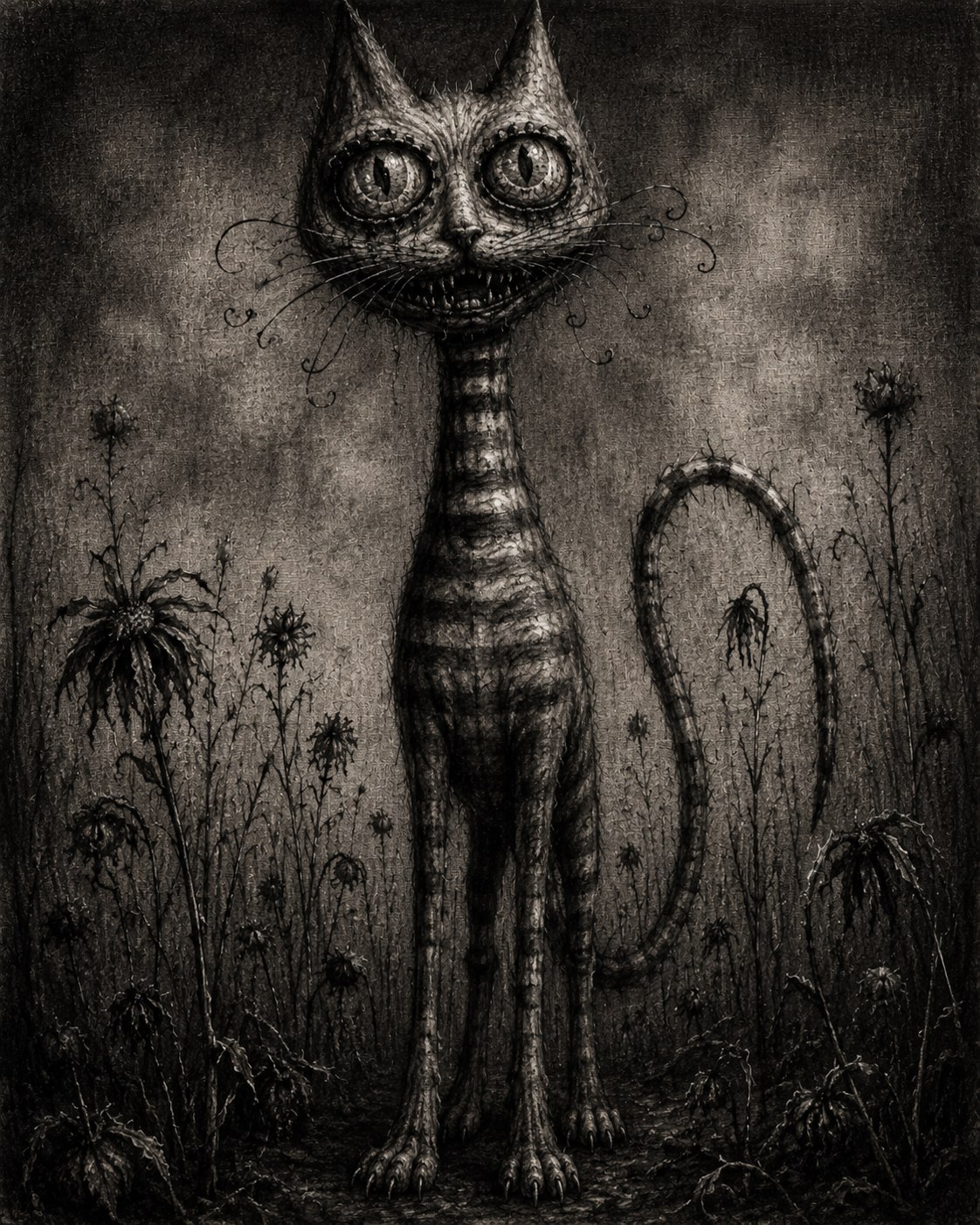
THIS IS A WORK OF FICTION
The first cat came out of a spelling copy in a tea stall near Shyambazar, between the words umbrella and uncle, on a Tuesday afternoon when Kolkata was lying under the heat like an old patient under a damp bedsheet.
Nobody noticed it immediately.
There was a tram bell clanging at the crossing, a bus conductor hanging from the footboard and shouting “Belgachia, Paikpara, Dum Dum,” a delivery rider arguing with a taxi driver, and five men at Haru’s stall performing the daily autopsy of the state government with the calm authority of surgeons who had mislaid the body. Above them, on a cracked balcony, a red petticoat dripped rainwater from the previous night. Political posters peeled from a wall in papery strips: one leader’s eye gone, another’s smile stretched into fungus.
At the corner table, little Riju Das was drawing while his mother drank tea from a glass and scolded someone on the phone about school fees.
The crayons were new.
Not new in the proper way, with glossy packaging and English names pretending to be European, but new in the Kolkata way: suddenly everywhere, piled beside cheap erasers, plastic tiffin boxes, fake Pokémon stickers, exam pads, incense sticks, balloons, and Chinese fairy lights. The brand was called Happy Jaanu Wax Colours. On the packet, a round-eyed tiger and a pink dog danced beneath a rainbow. Twelve colours, only thirty rupees. Non-toxic, washable, extra bright. There was no manufacturer’s address, only “Made for Indian Children” in bold red letters, which was the kind of sentence that makes sensible people nervous and nobody else.
Riju drew a cat.
It had one green eye, one orange eye, four legs of different lengths, and teeth like a broken comb. Then his mother said, “Enough. Drink water,” and the boy shut the copy.
That was when the cat slid sideways between the pages.
It came out flat at first, as if it were a shadow that had forgotten what object it belonged to. Then the lines thickened. Crayon wax gathered itself into spine, rib, claw. The thing dropped soundlessly onto the newspaper spread beneath Haru’s muri jar. It was no bigger than a slipper.
It was also wrong.
Not wrong because it was alive. Kolkata has always accommodated the impossible by pretending it is municipal negligence. Wrong because it looked drawn even after becoming flesh. Its outlines trembled. Its body was black where Riju had pressed hardest, pale where his hand had grown bored. Its whiskers were green. It had no fur, only greasy wax, and when it opened its mouth, the teeth were still the teeth of a child’s drawing: too many, too eager, arranged by someone who did not yet know mercy.
The cat ate a cockroach.
Then it ate the corner of the newspaper.
Then it looked up at Riju.
The boy screamed only after it smiled.
By evening, the video had reached every para WhatsApp group between Barasat and Behala. The captions multiplied faster than facts. Tantrik matter. Chinese virus crayons. New chemical attack on Hindu children. Fake AI video. Forwarded as received. In the video, men shouted, Haru swung a tea strainer like a weapon, and the cat, cornered under the bench, inflated itself into a scribbled black cloud before slipping into the drain.
At 8:15 that night, in a one-room flat near Sinthee More, Mira Sen watched the video three times.
She did not laugh.
Mira was thirty-eight and had once drawn animals for children’s books: owls wearing spectacles, crocodiles with moral confusion, monkeys who learned table manners. That was before the publishing house closed, before app-based educational content became the new god with headphones, before illustration rates fell through the floor and the floor turned out to be another floor, also falling. Now she designed worksheets for a coaching-center chain whose slogan was Every Child Is a Rank Waiting to Happen. She spent her days arranging cartoon mangoes into subtraction problems.
Her nephew Ishaan sat beside her on the bed, colouring a bird with fierce concentration. He was six, narrow-shouldered, serious, and recently fatherless. Mira’s younger brother had died eighteen months ago at a private hospital off EM Bypass, where every hour came itemised and the bill had looked less like a demand for money than a thesis on human helplessness.
Since then Ishaan and his mother, Nandita, had moved in with Mira. Three people in one room. Two incomes if one counted Nandita’s tailoring. No privacy. No silence. Much love, but of the cramped variety, like plants grown in tea tins.
“Where did you get those?” Mira asked.
Ishaan looked up. “Bappa-kaku gave discount.”
The packet lay open near his knee.
Happy Jaanu Wax Colours.
Mira picked it up. The tiger on the cover had a wet-looking red smile.
“Don’t use these.”
“Why?”
“Bad quality.”
“But they are bright.”
“They are too bright.”
This answer satisfied nobody, least of all herself.
Nandita came in from the balcony, where she had been folding school uniforms under the light of a neighbour’s window because their own tube light had begun its nightly flicker. “Again you are frightening him? Let him draw. He has homework.”
“These crayons are in that video.”
Nandita made the face Bengali women make when a household already full of grief is offered nonsense as a side dish. “One cat video and you will stop his schoolwork? Tomorrow madam will write note. You go explain to her.”
“It came out of the page.”
“Everything comes out of the phone now,” Nandita said. “Ghost, god, loan app, exam result, marriage proposal. Put it away.”
But she looked at the bird in Ishaan’s copy.
It was blue. Its beak was red. It had a human eye because Ishaan did not yet understand birds. It looked embarrassed to have wings.
That night, there was a power cut at 10:40.
The whole building sighed and rearranged itself. A baby began crying upstairs. Someone cursed CESC. From the lane below came the wet slap of slippers, the ding of a cycle bell, the cough of a generator from the new gated tower beyond the old pond. In darkness, Kolkata became audible: pressure cookers, television fragments, mosquitoes, lift alarms, a dog defending its philosophical position against another dog.
Mira lay awake beside Ishaan. Nandita slept on the floor mattress, one arm across her face.
A soft tapping came from the table.
Mira held her breath.
Tap. Tap-tap.
Like a beak on wood.
She reached for her phone. The battery was at nine percent. In the blue light, the room appeared underwater: steel almirah, plastic chair, schoolbag, buckets, old calendar of Goddess Lakshmi from a pharmacy.
The drawing copy on the table was trembling.
The blue bird’s head pushed through the page.
It emerged with effort, tearing fibres, its paper body becoming a greasy crayon thing as it squeezed itself into the room. It was smaller than Mira’s palm. Its wings were not wings but two blue smears. Its red beak opened and closed without sound.
Mira did not scream. Some terrors are too clerical for screaming. They require observation first, panic after.
The bird hopped once.
Then it spoke in Ishaan’s voice.
“Bapi?”
Nandita woke immediately.
The bird turned toward her. Its human eye widened. It opened its beak again, and the second voice came out deeper, tired, unmistakable.
“Don’t sign.”
Nandita made a sound like cloth ripping.
The bird burst.
Not exploded. Burst, like an overripe fruit pressed between fingers. Blue wax splattered across the table, the wall, Mira’s cheek. The smell filled the room: burnt candle, wet paper, hospital antiseptic.
Ishaan slept through it.
In the morning Nandita refused to discuss the voice.
“What did it mean?” Mira asked.
“It was a bad dream.”
“We both saw it.”
“No. You saw your thing. I saw mine.”
“What sign?”
Nandita bent over the stove and lit the burner with three sharp clicks. “Tea?”
“Nandi.”
“Tea or no tea?”
Mira understood then that her sister-in-law was hiding something, and that the hiding was not new. Grief had made Nandita quieter, but this was different. This was the silence of a person standing in front of a locked cupboard.
At 11:30, after sending Ishaan to school without the crayons, Mira went to Bappa’s stationery shop.
Bappa Roy had inherited half a shop from his father and all of his father’s talent for survival. He sold pens, notebooks, puja garlands, phone covers, printer cartridges, birthday candles, and, during exam season, faith. His counter was a narrow democracy of necessity. Poor mothers bought one pencil at a time. Coaching students bought highlighters in colours of ambition. Retired uncles came for envelopes and gossip.
The Happy Jaanu packets were stacked beside geometry boxes.
“Where did these come from?” Mira asked.
Bappa looked wounded. “Why? Problem?”
“You saw the video.”
“Didi, if I stopped selling everything from WhatsApp video, I would have to sit naked in empty shop.”
“They are dangerous.”
“Everything cheap is dangerous,” he said, lowering his voice. “Cheap wire burns, cheap medicine fails, cheap tuition ruins, cheap politics kills. But tell me one thing. Rich people’s danger comes with warranty. Poor people’s danger comes with discount.”
It was the kind of sentence that would have sounded noble if it had not been spoken by a man currently selling haunted crayons to children.
“Who supplied them?”
He scratched his chin. “One man. Came with tempo. Said school clearance stock.”
“Name?”
“Cash business.”
“Bappa.”
He sighed. “There was a sticker on carton. Old godown near Chitpur side. Basak Lane, maybe. But don’t go. Police also went yesterday.”
“Police?”
“After the dog.”
“What dog?”
He showed her another video.
This one was from a cheap café near Girish Park, where college students sat for hours over one cold coffee and three revolutions. A girl had drawn a dog on a tissue. The dog had crawled out under the table and grown to the size of a goat. It had no skin except yellow crayon. Its tail was a question mark. It wagged happily while biting through a chair leg. Then it bit a man’s calf and left not teeth marks but crayon marks, deep purple punctures smoking at the edges.
By afternoon, more reports came.
Matchstick men marching out of nursery copies in a school near Lake Town, thin black figures with round heads and no faces, climbing curtains and whispering multiplication tables.
A green fish flopping through a bathroom drain in Ultadanga, leaving scales shaped like thumbprints.
A cow from a child’s homework chewing through a puja pandal’s thermocol lion.
A sun drawn above a house in Behala that rose from the paper and burned a perfect circle through a dining table.
The city did not stop. Cities never stop for the first sign of apocalypse. There are office logins to complete, blood tests to collect, autos to catch, rice to wash, old parents to lift from beds, EMIs to fear. Kolkata merely added the creatures to its inventory of inconvenience. People shut notebooks with bricks. Teachers banned drawing periods. Hawkers doubled the price of safer brands. Online sellers advertised “genuine imported non-demonic crayons” at four times the cost. A minister announced a committee.
Mira went to Chitpur.
Rain came in the late afternoon, sudden and theatrical, drumming on tin roofs, turning the tram tracks silver. Chitpur smelled of damp paper, engine oil, incense, rotten fruit, and old wood. She passed printing presses where men in vests fed invitation cards into machines, lanes where crumbling mansions leaned over the street like elderly relatives listening for scandal, shops selling masks, idols, brass utensils, school trophies, cheap gods, cheaper dreams.
Basak Lane was narrow enough for two scooters to quarrel.
The godown stood behind a locked iron gate. Its signboard had been painted over many times. Beneath the latest coat, Mira could make out old lettering: Sen Art & School Supplies.
Her father’s company.
She stood in the rain while the city tilted.
Sen Art had closed when Mira was twelve. Her father, Prabir Sen, had manufactured chalk, slate pencils, wax crayons, and watercolours in a small factory near Cossipore. Not famous, not big, but respectable in the old middle-class way, where failure wore polished shoes and spoke English to bank managers. Then a fire destroyed the mixing room. One worker died. Compensation cases followed. Debt arrived with files. Her father sold everything, stopped speaking at dinner, and died ten years later of what the doctor called heart failure and her mother called shame.
Mira had not thought of the factory in years.
That was untrue. She had thought of it whenever she smelled warm wax.
The gate was not properly locked.
Inside, the godown was dark and humid. Cartons were stacked along the walls. Rats moved like bad thoughts. On one table lay torn labels, broken crayons, mouldy registers, and a hand-operated mixing machine with rust around its mouth.
A child laughed somewhere.
Mira froze.
“Who’s there?”
A figure stepped from behind the cartons. Not a child. A man of about sixty, thin as a bamboo pole, wearing a rain-spotted shirt and plastic sandals. He held a torch in one hand and a packet of Happy Jaanu in the other.
“You are Prabir-babu’s daughter,” he said.
Mira knew him after a moment. “Madan-da?”
Madan Pal had worked in her father’s factory. He had once brought her orange lozenges and shown her how wax softened in heat.
“You’re making these?”
“Not making,” he said. “Finishing.”
“What does that mean?”
He smiled with only one side of his mouth. “Your father left many things unfinished.”
A sound came from the far wall. Scratching.
Madan pointed the torch.
Dozens of drawings moved across the damp plaster. Cats, birds, dogs, stick figures, suns, trees, houses, long-armed mothers, square fathers, monsters with triangular teeth. They crawled over one another in flat silence, trapped in the wall like insects under glass.
“They don’t last long outside,” Madan said. “Unless the child presses hard. Unless there is feeling.”
“What are they?”
“Children,” he said. “What else?”
Mira backed away.
“Not bodies,” he said. “Don’t make that face. Not exactly. Wishes. Fears. The part of a child that enters the line before the child learns to draw properly. Before school teaches neatness. Before parents teach salary. Before the world teaches them to make everything look acceptable.”
“You’re insane.”
“Yes. But also correct. Very common combination in this city.”
He opened an old register. The pages were swollen, ink blurred but legible. Batch numbers. Pigments. Wax ratios. Additives. Names of workers.
And one entry circled in red.
Bone black supplied from Nimtala. Experimental pigment. Superior depth.
Mira felt cold beneath her wet clothes.
“Your father used cremation ash?”
“Everyone used something,” Madan said. “Powder, filler, industrial waste. Margins were small. Schools wanted cheap. Parents wanted cheap. Government tenders wanted cheaper than cheap. Respectable men do ugly things with invoices.”
“My father wouldn’t—”
“He did. Then the fire came. The mixing room burned. Ash, wax, turpentine, rainwater, one dead worker, thousands of rejected crayons melted together. After that, drawings began moving. Your father locked the stock away. I wanted compensation. He gave me nothing. Said the company had died.”
Mira remembered the dead worker’s name from adult whispers.
Palash.
Madan’s younger brother.
“So you released them now?”
“I sold what was owed.”
“To children?”
His face changed. For the first time, something like shame crossed it, quick and ugly. “Children are the only ones who can open them.”
Behind him, a matchstick man detached itself from the wall and dropped onto a carton. Its head turned toward Mira though it had no eyes.
Madan whispered, “They are not cute because children are not cute inside. Adults make them cute. Children know the world is teeth first.”
Mira ran.
Outside, the rain had become a white sheet. She slipped near the gate, cut her palm, and kept running until she reached the main road, where buses roared past with their windows fogged and human faces floating inside like aquarium fish.
Her phone showed eleven missed calls from Nandita.
Ishaan had collapsed at school.
At the hospital near Maniktala, the corridors were full, because corridors in Kolkata hospitals are not passageways but settlements. Families sat on newspapers. Someone argued over a deposit. A boy vomited into a plastic bag. Nurses moved with the tired anger of people holding up civilization with clipboards.
Ishaan lay on a bed in the emergency ward, asleep under harsh white light. His fingers were stained with blue.
Nandita sat beside him, face grey.
“They found him in drawing class,” she said. “He had hidden one crayon in his pocket.”
“What did he draw?”
Nandita did not answer.
Mira found the paper in Ishaan’s schoolbag.
It showed a family: mother, aunt, small boy, and a man with a round smiling face. Above them, a blue bird. Below them, in uneven letters: BAPI COME HOME.
The father in the drawing had been rubbed hard into the page. So hard the paper had nearly torn.
Mira remembered the bird’s voice.
Don’t sign.
She looked at Nandita.
“What are you supposed to sign?”
Nandita covered her mouth.
The truth came out without drama, which is how the worst truths often arrive. The hospital where Mira’s brother had died had offered Nandita a settlement. Not an admission. Never that. A compassionate assistance package, in exchange for withdrawal of complaint and confidentiality. The amount was large enough to pay debts and small enough to insult the dead.
“I was going tomorrow,” Nandita said. “I didn’t tell you because you would say no. Saying no is easy when school fees are not looking at you.”
Mira sat down.
She wanted to be righteous. Righteousness is the cheapest luxury of people not holding the bill.
On the bed, Ishaan opened his eyes.
“Aunty,” he whispered. “Bapi is in the wall.”
The lights went out.
For three seconds, the ward was completely dark.
Then emergency lamps flickered on, red and weak.
Every child in the ward began screaming.
Drawings were coming out everywhere.
A dinosaur from a plaster cast. Flowers from a get-well card. A black sun from the back of a prescription. A row of stick nurses from a toddler’s notebook, each carrying a needle longer than its body. They slid down walls and bed rails, soft and glistening. A purple dog with three heads dragged itself from under a chair. A house with windows like eyes unfolded from a chart and stood on four trembling legs.
People ran. IV stands crashed. Someone shouted for security. Someone shouted God’s name with the efficiency of a person dialling emergency services.
Mira grabbed Ishaan.
The blue bird appeared at the foot of the bed.
It was larger now. Its red beak was cracked. Its human eye looked like her brother’s eye after fever, tired and amused and already far away.
“Don’t sign,” it said again.
Then the purple dog pounced.
Nandita lifted a steel stool and struck it. The dog flattened, re-formed, and came again. Its crayon mouth opened wide enough to show the drawing inside the drawing: smaller dogs, smaller mouths, hunger nested inside hunger.
Mira saw then what Madan meant. The creatures were not evil. Evil had plans. These things had only the purity of first feelings. Want. Fear. Anger. Come back. Don’t leave. Look at me. Feed me. Save me. A child’s heart, released without a child’s helpless body to limit it.
That made them worse.
She seized the Happy Jaanu blue crayon from Ishaan’s pocket.
It was warm.
“What are you doing?” Nandita cried.
“Drawing something bigger.”
On the back of the settlement form sticking from Nandita’s handbag, Mira drew.
For years she had drawn safely: cheerful mangoes, correct owls, polite crocodiles. Now she drew as she had drawn before prizes and clients and invoices. She pressed until the crayon broke. She drew a door. Not a nice door. An old north Kolkata door, tall, wooden, warped by monsoon, with iron studs and a bar across it. She drew darkness behind it. She drew a lock shaped like an eye. She drew teeth along the frame because every door in this city eats someone’s chance.
The paper buckled.
The door rose.
It stood in the middle of the emergency ward, taller than any human being, blue and trembling, smelling of wax and rainwater and old ash.
The creatures paused.
Mira understood the rule without being told. Children made life. Adults made exits.
“Go,” she said.
The blue bird hopped toward the door.
Nandita cried out, “No.”
The bird turned. Its beak opened. This time, when it spoke in her husband’s voice, it said, “Live.”
Then it entered.
One by one, the creatures followed. Dog, sun, house, flowers, stick nurses, matchstick men. Some resisted. Some clawed the floor. The door pulled them not by force but by recognition. All drawings know paper. All ghosts know ash.
Last came the father from Ishaan’s page.
He was badly made, round-headed, smiling, one arm longer than the other. He climbed from the school drawing and stood beside the bed. For a moment he was almost a man. Almost enough to ruin everyone.
Ishaan reached out.
The figure touched the boy’s forehead, leaving a blue thumbprint.
Then it went through the door.
Mira shut it.
The door folded into the settlement form and left behind a blank rectangle.
Afterward, the city behaved as cities do after shameful miracles. It denied, joked, monetised, forgot. The government banned Happy Jaanu Wax Colours. Police seized cartons from shops. News channels ran graphics of killer crayons chasing schoolchildren while experts shouted over one another. Bappa claimed he had always suspected the product. Madan Pal disappeared. The godown burned three nights later in a fire officially attributed to faulty wiring, that reliable old citizen of Kolkata.
Nandita did not sign.
This did not make life easier. It only made one kind of difficulty cleaner than another.
A week later, Mira returned to the flat from the market with potatoes, eggs, and one packet of expensive crayons bought from a proper shop with a proper bill. Ishaan was on the balcony, watching rainwater drip from the neighbour’s clothesline. The city below steamed gently. A puja committee tested lights in June, because hope and fundraising both require advance planning. Somewhere a metro announcement floated up and dissolved in traffic.
On the table lay a sheet of paper.
Mira looked at it and stopped.
Ishaan had drawn nothing.
The page was blank except for one blue thumbprint in the middle.
As she watched, the thumbprint opened its eye.